Zakat al Fitr: Who Pays, How Much, and When
A small due at the end of Ramadan: food for the poor, and a cleaning of the month. Here is who pays, what a sa' is, the cash disagreement, and why the Eid prayer is the deadline.
Eid clothes are already on a chair, and someone in the group chat asks what "the fitr" is this year. A number appears. Another number appears. A cousin says cash is fine. An uncle says only rice counts. The month you just fasted is about to end, and a small due is still sitting on the table.
It is small. It is not optional for the person who can pay it. Ibn Umar (may Allah be pleased with him) said the Messenger of Allah ﷺ made zakat al fitr obligatory: one sa' of dates or one sa' of barley, on every Muslim, slave or free, male or female, young or old, and he ordered that it be given before the people went out to the Eid prayer (Sahih al-Bukhari 1503).
This is not the zakat of wealth. That one waits for a lunar year and a nisab. This one belongs to the closing of the fast. It is also not fidya. Fidya is for a body that cannot make the days up. We already drew that line in Ramadan fasting rules.
Count the heads in the house. Ask the mosque what a sa' costs this year. Give it before you walk to Eid. The rest is detail.
What it is for
Ibn Abbas (may Allah be pleased with him) said the Messenger of Allah ﷺ prescribed zakat al fitr as a purification for the fasting person from idle and obscene talk, and as food for the poor. Whoever pays it before the prayer, it is accepted zakat. Whoever pays it after, it is ordinary charity (Sunan Abi Dawud 1609, graded hasan by al-Albani).
Two jobs, one scoop. The month had a tongue. The poor still have to eat on Eid morning. The due is not a tip for a good Ramadan. It is how the fast leaves the house clean, and how a neighbour who fasted hungry does not watch the feast from the door.
Give it to the poor and needy among the Muslims. If you cannot find anyone where you live, appoint someone trustworthy in another country. That is a known permission. It is not an excuse to forget until the sermon has started.
Who pays
Every Muslim who has more than they need for the day of Eid. Young and old. The parent pays for the child. Ibn Umar used to give even on behalf of Nafi's children (Sahih al-Bukhari 1511).
The common teaching, and the one Islam Q&A writes with, is that you also pay for the people whose maintenance sits on you: a wife, the children, a parent who has no means (IslamQA 207225, 510069). The Hanafi school treats an adult who has their own means as paying for themselves, a wife included. Do not flatten that. Count the heads the mosque you will use already counts.
A foetus is not a debt. The scholars treated that as agreed. Some of the companions liked to give for one, and Uthman's practice is why later teachers call it recommended, not required (IslamQA 27005, 207225).
A new Muslim who still has the month in their bones: if you can put food on your own Eid table, this due is yours too. We said so, briefly, in first Ramadan. You do not also owe a full zakat of savings unless a year has passed on the nisab.
If you yourself would be a rightful recipient, you do not pay. The poor eat. They are not asked to take from their own plate to feed the poor.
How much
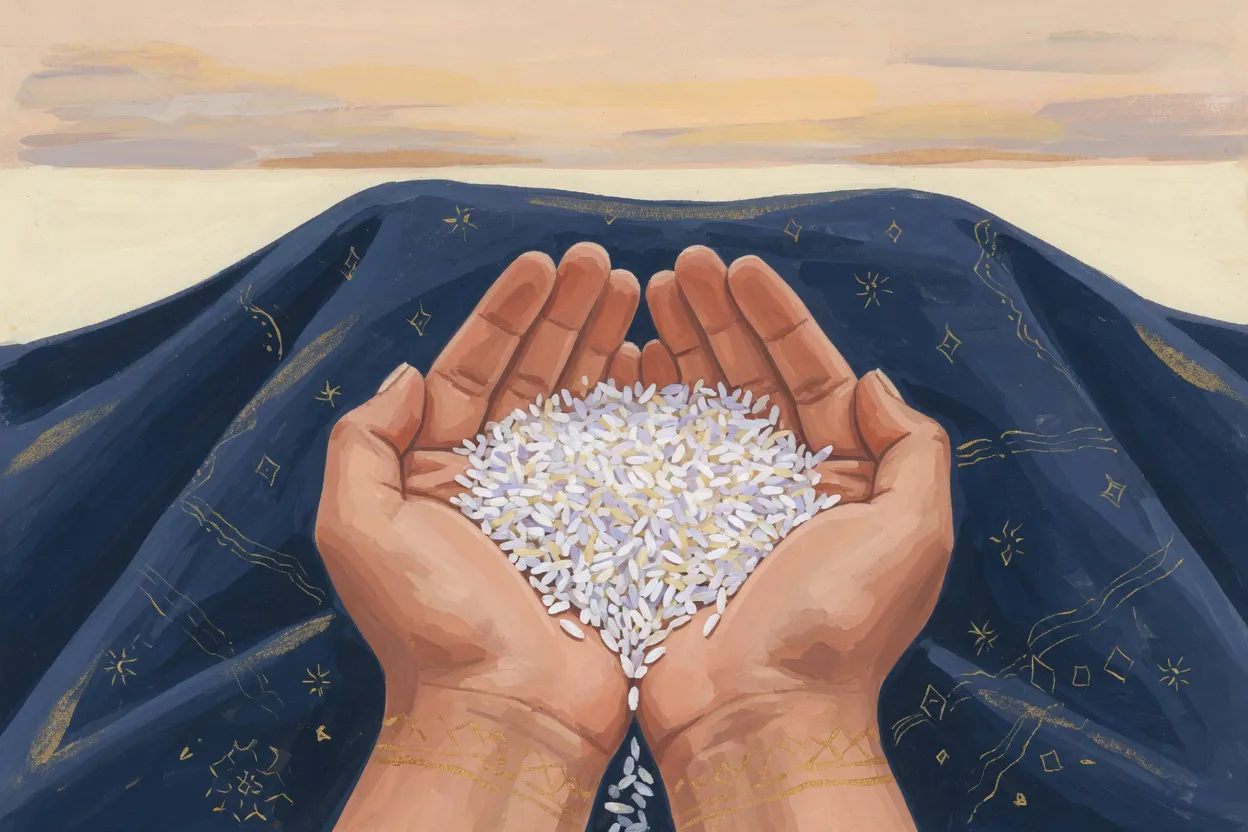
One sa' of the staple food of the land. Dates and barley are the wording in Bukhari 1503. Abu Sa'id al-Khudri (may Allah be pleased with him) said they used to give a sa' of food, or barley, or dates, or dried yoghurt, or raisins (Sahih al-Bukhari 1506). Later people in Madinah sometimes used half a sa' of wheat. Ibn Umar kept giving dates, and barley when dates were scarce (Sahih al-Bukhari 1511).
A sa' is a measure of volume, not a supermarket bag. Four double handfuls in the Prophetic measure. In modern weight the scholars disagree because rice is heavier than barley, and new grain is heavier than old:
- Many contemporary fatwas, including Ibn Baz, treat it as about three kilograms.
- Ibn Uthaymin estimated about 2.1 kilograms.
Give a little more if you are unsure. Do not invent a dollar figure from this page. Ask the mosque you will pray Eid in. They already priced a sa' of the local staple. That number changes with the year and the city. A site that prints "$15 everywhere" is guessing.
Rice, wheat, couscous, the food people actually eat where you live: that is the stronger reading of "food" in Abu Sa'id's report. Help the poor with what they cook, not with a grain they will not open.
Food or cash
The Prophet ﷺ and his companions gave food. The majority of scholars keep it as food. Islam Q&A is firm on that (IslamQA 1396, 49793).
The Hanafi school allows the value in money. Many mosques in Europe and North America collect cash because they can turn it into food, or because the poor in that city asked for money. That is a real disagreement, not a personality test.
We will not flatten it. If your teacher and your mosque take food, give food. If they take a cash equivalent they have priced from a sa', and that is the madhhab of the house you pray in, you have not invented a new rite. Do not send a random transfer and call it fitr because a story sticker said so.
What we will not do is tell you that cash is "the modern sunnah." It is not. Food is the sunnah. Cash is an ikhtilaf some communities use so the poor are actually fed.
When
Before the people go out to the Eid prayer (Sahih al-Bukhari 1503). After the prayer, Ibn Abbas's report calls it ordinary sadaqah (Sunan Abi Dawud 1609). The due still wants to be paid. The name on it has changed.
The companions used to give it a day or two before Eid (Sahih al-Bukhari 1511). That is the short window a lot of mosques still keep, and the one Islam Q&A holds: one or two days, three if there is a need, not a week or two (IslamQA 37636, 207225).
The schools do not all sit in that last pocket. The Shafi'i school allows giving from the start of Ramadan. A known Maliki reading stays with the companion days; another allows more of the month. The Hanafi school is the most generous with early payment. We will not pick a winner. Give it when your mosque is collecting, and do not miss the prayer.
Do not wait for the morning of Eid if your mosque's collection closes the night before.
For 2027, if the first fast is 8 February as the dates hub currently expects, Eid is projected around 9 or 10 March. That is when the deadline, and the short companion window, fall. Pencil. Confirm when the crescent of Shawwal is seen. The deadline is still the prayer, not a date we printed in August.
The six week prep asked you to count this in Sha'ban. If you did not, count it tonight. A late count is better than an Eid morning panic.
A sequence you can keep
- Write every Muslim whose food is yours this Eid: yourself, a wife if that is your house's teaching, the children, anyone else you spend on.
- Ask the mosque the price, or the weight, of one sa' this year.
- Give food, or the cash your community accepts as its stand-in, when the mosque is collecting and before the prayer.
- Keep a note that it left the house before you put on the Eid clothes.
Deeny will not calculate this for you, and it should not. A zakat app that needs your salary and your address to tell you the price of rice has already misunderstood the due. The mosque already knows.
Frequently Asked Questions
Is zakat al fitr the same as ordinary zakat?
No. Ordinary zakat is 2.5 percent of qualifying wealth after a lunar year. Zakat al fitr is a sa' of food at the end of Ramadan, per person.
Can I pay zakat al fitr in cash?
The sunnah is food. The majority keep it as food. The Hanafi school allows the value. Follow the mosque and teacher you actually use. Do not invent a number online.
How many kilograms is a sa'?
A sa' is volume. Estimates run from about 2.1 kg to about 3 kg depending on the grain. Ask your mosque. Give a little extra if you are unsure.
Do I pay for my children?
Yes, if you can. Ibn Umar gave for the young as well as the old (Sahih al-Bukhari 1511). A foetus is recommended, not required (IslamQA 27005).
Do I pay for my wife, or for parents who live with me?
The common teaching is yes, if their maintenance is yours (IslamQA 207225, 510069). The Hanafi school has an adult with their own means pay for themselves. A parent who is independent pays their own. Ask the mosque if the household is messy.
Can I pay at the beginning of Ramadan?
The Shafi'i school allows it. Others keep it to the last day or two. Follow the collection you will actually use. The deadline is still the Eid prayer.
What if I miss the Eid prayer deadline?
Pay it anyway. Ibn Abbas's report then counts it as ordinary charity (Sunan Abi Dawud 1609, hasan). Do not skip it because you were late.
Is this the same as fidya for missed fasts?
No. Fidya feeds a poor person for a day you cannot make up. Zakat al fitr is due even if you fasted every day. A person who owes both, owes both.
Write the names. Carry the bag, or the envelope the mosque asked for. Then go to the prayer. The poor should eat on the morning you celebrate. The month should leave your tongue cleaner than it found it.