Duha Prayer: Its Time and How Many Rak'ah
In this article · 6
Duha is the voluntary forenoon prayer. Its time runs from when the sun is fully up until it passes its height, and the reports give two rak'ah as enough, four as the Prophet's ﷺ usual count, and eight on the day of the conquest of Makkah. You can pray it on any morning, at home, at work or on the road, in a few quiet minutes.
This guide gives each report with its collection, its number and its grade, all read on sunnah.com.
Every report quoted here is in Sahih al-Bukhari or Sahih Muslim, and its grade is the collection's own, sahih: sunnah.com shows no separate grade for these two collections. Where a question needs a ruling for your own case, it says so and leaves the answer to your teacher.
What the Duha Prayer Is
Duha is the forenoon: the bright part of the morning, after the sun has risen. The Duha prayer is a voluntary prayer offered in that part of the day. It is not one of the five obligatory prayers that our guide to the five daily prayers explains. It belongs with the voluntary prayers mapped in our guide to sunnah and nafl prayers.
Its place in the Sunnah rests on short, clear reports. Abu Hurayrah said: "My friend (the Prophet) advised me to do three things and I shall not leave them till I die": "To fast three days every month, to offer the Duha prayer, and to offer witr before sleeping" (Sahih al-Bukhari 1178).
Abu Dharr reported that the Prophet ﷺ said: "In the morning charity is due from every bone in the body of every one of you." The hadith counts glorifying Allah (SWT), praising Him, enjoining good and forbidding wrong among those charities, and it ends: "and two rak'ahs which one prays in the forenoon will suffice" (Sahih Muslim 720).
Read that second hadith slowly. Every joint of your body owes a charity each morning, and two rak'ah are enough to pay it.
When Its Time Starts and Ends
The clearest map of the morning is the hadith of Amr ibn Abasa (Sahih Muslim 832). The Prophet ﷺ told him: "Observe the dawn prayer, then stop praying when the sun is rising till it is fully up."
He went on: "Then pray, for the prayer is witnessed and attended (by angels) till the shadow becomes about the length of a lance; then cease prayer, for at that time Hell is heated up. Then when the shadow moves forward, pray."
Imam al-Nawawi gathered the Duha reports in Riyad as-Salihin. The Arabic title of the chapter that holds hadith 1143 says that Duha may be prayed from the time the sun has risen high until it passes its height (zawal), and that it is best when the heat grows strong and the forenoon is well advanced.
| Part of the morning | Duha | Source |
|---|---|---|
| From Fajr until the sun is fully up | Not yet: "stop praying" | Sahih Muslim 832 |
| The sun fully up, early forenoon | Its time has begun | Sahih Muslim 832; Riyad as-Salihin, chapter of 1143 |
| The heat grows strong, late forenoon | Its best time | Sahih Muslim 748a; Riyad as-Salihin, chapter of 1143 |
| The short pause the hadith marks by a lance's shadow | Its time is over: "cease prayer" | Sahih Muslim 832 |
| "When the shadow moves forward" | Prayer again, until Asr | Sahih Muslim 832 |
The hadith gives no number of minutes. On your timetable, sunrise and Dhuhr are the two edges, and Duha sits between them, with a margin after sunrise and another before Dhuhr. Sunrise is also the moment Fajr's time ends. How wide each margin should be is a question for your local mosque.
The Best Time: When the Heat Rises
Zaid ibn Arqam once saw people praying early in the forenoon. Sahih Muslim 748a records what he said: "They well know that prayer at another time than this is more excellent, for Allah's Messenger (ﷺ) said: The prayer of those who are penitent is observed when your weaned camels feel the heat of the sun."
The penitent (al-awwabin) are those who turn back to Allah (SWT) again and again. The young camels feel the heat when the sun has climbed well into the sky, and al-Nawawi's chapter title reads the hadith that way: the best Duha is prayed when the heat grows strong.
So you have two good choices. Pray early, once the sun is fully up, and you are inside Duha's time. Pray in the late morning, before the midday pause, and you have also met the moment the hadith praises. If your mornings are full, the early prayer is still Duha.
How Many Rak'ah: What Each Report Says
Three reports give a number. Each is in one of the two Sahih collections, and sunnah.com shows no separate grade for those, so the grade below is the collection's own.
| Rak'ah | Reported by | Reference | Grade |
|---|---|---|---|
| 2, "will suffice" | Abu Dharr | Sahih Muslim 720 | Sahih |
| 4, "sometimes more as he pleased" | Aisha | Sahih Muslim 719a | Sahih |
| 8, on the day of the conquest of Makkah | Umm Hani | Sahih al-Bukhari 1176 | Sahih |
Asked how many rak'ah the Prophet ﷺ prayed at the forenoon prayer, Aisha replied: "Four rak'ahs, but sometimes more as he pleased" (Sahih Muslim 719a).
Umm Hani said: "On the day of the conquest of Mecca, the Prophet (ﷺ) entered my house, took a bath and offered eight rak`at." She added: "I had never seen the Prophet (ﷺ) offering such a light prayer but he performed bowing and prostrations perfectly" (Sahih al-Bukhari 1176).
Aisha also said: "I never saw the Prophet (ﷺ) offering the Duha prayer but I always offer it" (Sahih al-Bukhari 1177). Al-Bukhari placed it under the chapter "Whoever did not offer the Duha prayer and thought it permissible (to offer it)". How her two reports fit together is a question your teacher can walk you through.
This guide sets no upper limit. The reports name two, four, eight and "more as he pleased". If you want to pray more than eight, ask a local scholar.
How to Pray It, Step by Step
- Check the time. The sun is fully up, and Dhuhr has not come in.
- Make your intention for the Duha prayer, a voluntary prayer for Allah (SWT) alone.
- Pray two rak'ah as you pray any voluntary prayer of two rak'ah. Our guide to performing salah step by step walks through each position.
- Keep it light, but whole. Umm Hani saw a light prayer whose bowing and prostrations were complete.
- For more than two, ask your teacher how to divide the rak'ah. This guide gives no form for that.
- Give it a fixed place in your morning: the first quiet minutes at work, or the break between classes.
If the night prayer is also on your heart, our guide to praying Tahajjud pairs well with this one: one prayer in the dark, one in the light.
Frequently Asked Questions
What time is the Duha prayer?
Duha is prayed in the forenoon: after the sun is fully up, and before it passes its height, which is when Dhuhr comes in. The hadith of Amr ibn Abasa (Sahih Muslim 832) forbids prayer while the sun is rising and at the midday pause. It gives no number of minutes, so ask your local mosque what margin to keep.
How many rak'ah is Duha?
The reports give two rak'ah as enough (Sahih Muslim 720), four as what the Prophet ﷺ usually prayed, "but sometimes more as he pleased" (Sahih Muslim 719a), and eight on the day of the conquest of Makkah (Sahih al-Bukhari 1176). All three are in the two Sahih collections. For how to divide more than two, ask your teacher.
When is the best time to pray Duha?
The best time is the late forenoon, when the heat grows strong. The Prophet ﷺ said: "The prayer of those who are penitent is observed when your weaned camels feel the heat of the sun" (Sahih Muslim 748a). The early forenoon, once the sun is fully up, is still Duha's time.
Is Duha the same as Ishraq?
None of the reports quoted in this guide uses the word ishraq. They speak of Duha, the forenoon, and of the prayer of the penitent when the heat rises (Sahih Muslim 748a). If your teacher or mosque uses the word, ask how they relate it to Duha.
Is the Duha prayer obligatory?
No. Duha is a voluntary prayer, not one of the five obligatory prayers. The Prophet ﷺ advised Abu Hurayrah to keep it, with fasting three days every month and witr before sleeping (Sahih al-Bukhari 1178).
Once Duha has a place in your mornings, Istiqama, the space for extra worship in Deeny Pro, keeps it, on iPhone, in your day's list with the Fajr sunna and the morning adhkar.
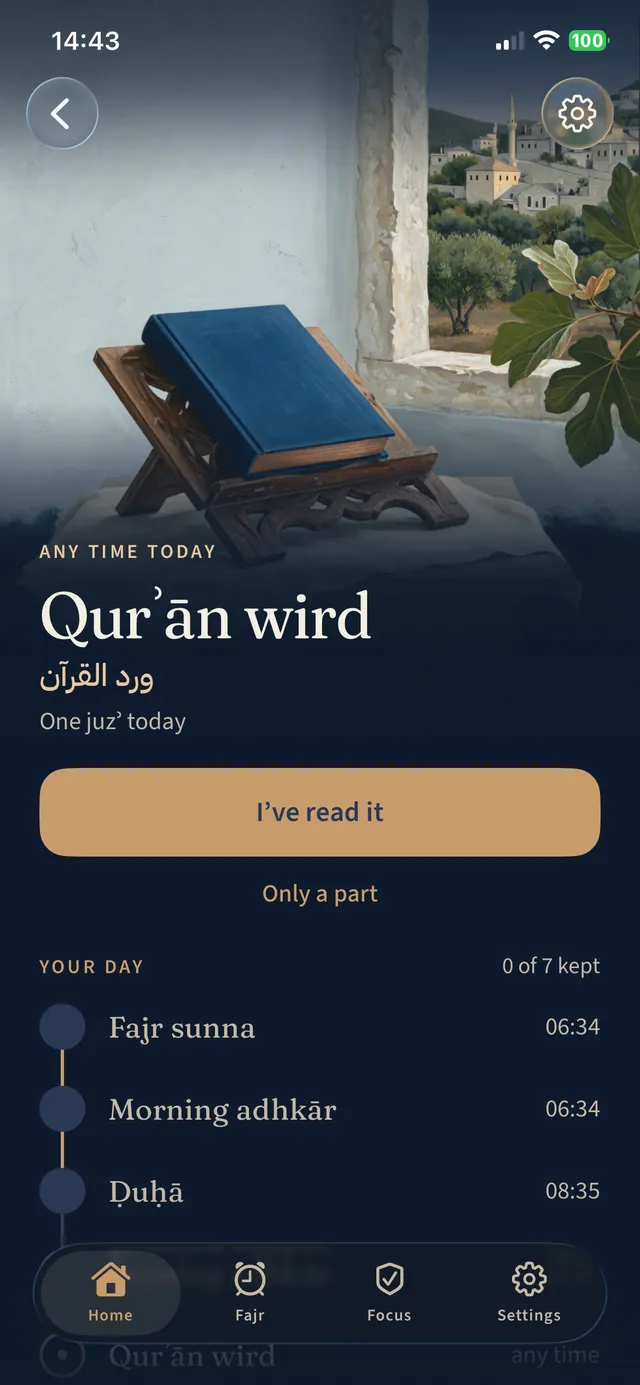
One app instead of three: prayer times, a lock that holds your chosen apps until you've prayed, and a Fajr alarm you can't snooze, with a tracker that shows your progress. Built by Muslims, for Muslims: no ads, your data never sold.
Sources named in this article
- Sahih al-Bukhari 1178
- Sahih Muslim 720
- Sahih Muslim 832
- Sahih Muslim 748a
- Sahih Muslim 719a
- Sahih al-Bukhari 1176
- Sahih al-Bukhari 1177

Ready for a gentle return?
Deeny helps you pray on time, with accurate prayer times, reminders and the Qibla for free. Deeny Pro gently locks distracting apps until you've prayed and keeps an honest tally. No ads, no sign-up, no selling your data.


Keep reading
 Islamic GuidelinesSunnah and Nafl Prayers: A Complete Guide to Voluntary Salah
 How-To GuideHow to Perform Salah, Step by Step: A Beginner's Guide to Prayer
 How-To GuideTahajjud: How and When to Pray the Night Prayer
 Islamic GuidelinesDhul Hijjah 2027: Dates, Arafah, and Eid al Adha