When Does Fajr Start and End? A Clear Guide
Fajr begins at the true dawn and closes at sunrise. Why two prayer apps can still disagree by twenty minutes, what the degree settings actually mean, and what to do at high latitudes.
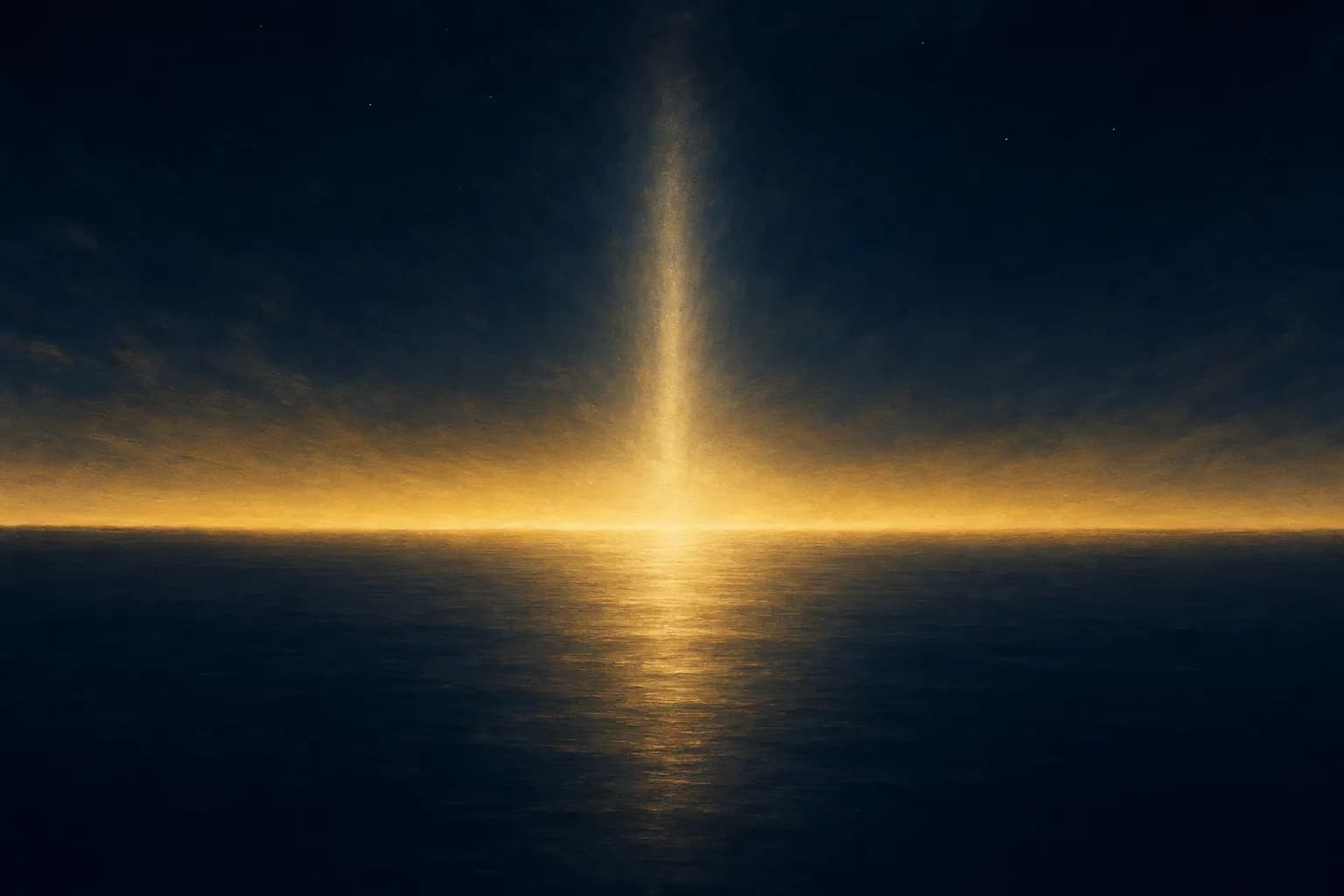
Fajr begins at the true dawn, the first horizontal spread of light along the horizon, and ends the moment the sun's upper edge appears. That is the whole rule, and for most of the year in most of the world it is entirely sufficient.
The complication is that "the first horizontal spread of light" is an observation, and your phone is not observing anything. It is running a calculation. Which is why two prayer apps, standing on the same street, can give you Fajr times twenty minutes apart, and why a question that sounds simple turns into the most technically contested prayer time of the five.
The Two Dawns
Arabic distinguishes two things that an English speaker would loosely call "dawn".
The false dawn (al-fajr al-kādhib) is a faint vertical column of light that rises up from the horizon, then fades back into darkness. It is real, you can see it in a dark enough sky, but it does not begin the prayer, and it does not end the permissible time for eating in Ramadan.
The true dawn (al-fajr al-ṣādiq) comes after it: a whitening that spreads horizontally along the horizon and does not recede. This is the one that matters. It opens the Fajr window and closes the pre-dawn meal.
The practical distinction the classical sources draw is direction and permanence: the false dawn stands up like a tail and then vanishes; the true dawn lies flat across the horizon and keeps growing.
When the Window Closes
Fajr ends at sunrise, specifically the first appearance of the sun's limb above the horizon.
This is a firmer boundary than most people realise. Fajr does not have a "late but still fine" tail the way Dhuhr or Isha do in practice; once the sun is up, the prayer's time has gone and what you offer is a make-up rather than the prayer in its window. The last portion before sunrise is also disliked to delay into deliberately, which is why "I'll catch it just before sunrise" is a poor plan even when it technically lands inside the window.
There is a separate and much-discussed case, waking after sunrise, having genuinely slept through it. That is not a failure of timing but a question of what to do next, and the schools differ on whether you pray immediately or wait a few minutes for the disliked period after sunrise to pass. We've handled that on its own in what to do if you missed Fajr.
Why Your App Says a Different Time
Here is the part almost nobody explains. Since we cannot ask an algorithm to look at the sky, prayer time calculations use a proxy: how far the sun is below the horizon. That angle is called the solar depression angle, and Fajr's is the single most disputed number in the whole system.
Different bodies have settled on different angles:
| Convention | Fajr angle | Used by |
|---|---|---|
| Muslim World League | 18° | Widely, especially Europe |
| Umm al-Qura (Makkah) | 18.5° (or a fixed 90 min) | Saudi Arabia |
| Egyptian General Authority | 19.5° | Egypt, parts of Africa |
| ISNA / FCNA | 15° | North America |
| Karachi (Univ. of Islamic Sciences) | 18° | Pakistan, India, Bangladesh |
The gap between 15° and 18° is not a rounding error. Depending on your latitude and the season it is commonly 10 to 20 minutes, and sometimes more. A 15° convention gives you a later Fajr; an 18° convention gives you an earlier one.
Neither is a madhhab position, and this is the key thing to understand: the four schools agree on the definition, Fajr begins at true dawn. What they never had to specify was a number, because they were describing something people looked at. The angles are a modern attempt to reproduce that observation arithmetically, and observers have measured true dawn anywhere from about 12° to 18° depending on latitude, season, altitude, and, increasingly, how much light pollution sits between you and the horizon.
The Fiqh Council of North America moved to 15° for the continental United States (and 13° for Canada) on exactly this reasoning: field observation suggested 18° was placing Fajr meaningfully before the visible true dawn at those latitudes.
Which Setting Should You Use?
The honest answer is the unsatisfying one: follow your local scholarly authority or the timetable your local masjid uses. This is a question of communal practice, not personal optimisation, and praying with your community has a value that shaving eight minutes off a calculation does not.
If you have no local reference, three practical guidelines:
- Match your region's convention, 15° in North America, 18° across much of Europe, Karachi in South Asia, Umm al-Qura in the Gulf.
- Do not switch conventions to make your life easier. Choosing the latest possible Fajr so you can sleep longer is optimising the wrong variable, and you will feel it.
- When in doubt, the cautious choice differs by act. For starting the prayer, waiting slightly is cautious. For stopping eating in Ramadan, the earlier time is cautious. These pull in opposite directions, which is precisely why a single "safest" answer does not exist.
Our guide to how prayer times are calculated covers the same machinery for the other four prayers, including the Asr shadow schools.
The High-Latitude Problem
North of roughly 48–50° latitude, something breaks. For part of the summer the sun never descends far enough below the horizon for true dawn to occur at all, astronomical twilight persists all night. In the UK this runs from roughly late April to late August; further north it lasts longer.
There is no true dawn to calculate, so a calculation must substitute something. Five approaches are in genuine scholarly use:
- Aqrab al-ayyām (nearest day), use the times from the closest date on which a true dawn did occur.
- Aqrab al-bilād (nearest land), use the times of the nearest location that still has a normal night, often taken as 45° latitude.
- Niṣf al-layl (middle of the night), split the interval from sunset to sunrise in half; Isha ends and Fajr begins at the midpoint.
- One-seventh of the night, divide the night into sevens and assign Fajr accordingly.
- A fixed interval: a set 90 minutes (or similar) before sunrise.
These produce materially different times, sometimes hours apart. This is legitimate ikhtilāf arising from a genuinely novel situation, not one convention being wrong. Follow your local mosque or scholarly body; if you are in the UK, several regional bodies publish timetables built on a stated method, and using one consistently matters more than which one you pick.
A Note on Trusting Your Phone
Whatever convention you choose, two mundane things break prayer times more often than any theological dispute:
- A wrong or stale location. If your phone has cached a location from a previous city, or you have denied location access and the app fell back to a default, every time will be wrong. This is the single most common cause of "my app's Fajr is off".
- A silently changed method. Some apps auto-select a calculation method based on your region and change it when you travel, without telling you.
Both are worth checking before concluding that a calculation is at fault. Deeny lets you set the calculation method explicitly and pins times to your actual location, and if the times still look wrong, our prayer app troubleshooting guide walks through the usual causes.
Frequently Asked Questions
What time does Fajr end?
Fajr ends at sunrise: the moment the upper edge of the sun appears above the horizon. Unlike some other prayers, there is no tolerated extension past that point: once the sun has risen, the window has closed and the prayer becomes a make-up. The period just before sunrise is also disliked to delay into deliberately.
What is the difference between the true dawn and the false dawn?
The false dawn is a faint vertical column of light that rises from the horizon and then fades back into darkness. The true dawn follows it: a whitening that spreads horizontally along the horizon and does not recede. Only the true dawn begins the Fajr prayer and ends the pre-dawn meal in Ramadan.
Why do prayer apps show different Fajr times?
Because they use different solar depression angles as a stand-in for observing the dawn. Common values are 15°, 18°, 18.5° and 19.5°, and the difference between them is typically 10 to 20 minutes. The definition of Fajr is agreed on; the arithmetic used to approximate it is not.
Should I use 15 or 18 degrees for Fajr?
Follow the convention used by your local masjid or scholarly authority. This is a matter of communal practice rather than personal preference. As a general guide, 15° is the Fiqh Council of North America's position for the continental US (13° for Canada), while 18° is standard across much of Europe and South Asia.
What do I do about Fajr in summer at high latitudes?
Above roughly 48–50° latitude, true dawn does not occur for part of the summer, so a substitute method is required, nearest day, nearest land, middle of the night, one-seventh of the night, or a fixed interval before sunrise. All five are in genuine scholarly use and give quite different times. Follow your local mosque or scholarly body, and stay consistent with one method rather than switching between them.
Fajr's definition is simple and has never really been in dispute: it starts when the true dawn spreads along the horizon and ends when the sun appears. Everything difficult about it comes from turning an observation into arithmetic. Pick the convention your community uses, set it deliberately rather than leaving it on a default, and then stop optimising, the minutes you would gain are worth far less than simply being ready when the window opens.