Suhoor and Fajr in Ramadan: When to Stop Eating
The last bite of suhoor and the first takbir of Fajr share one line in the sky. Here is that line, why two apps split it by twenty minutes, and how to stop eating without guessing.
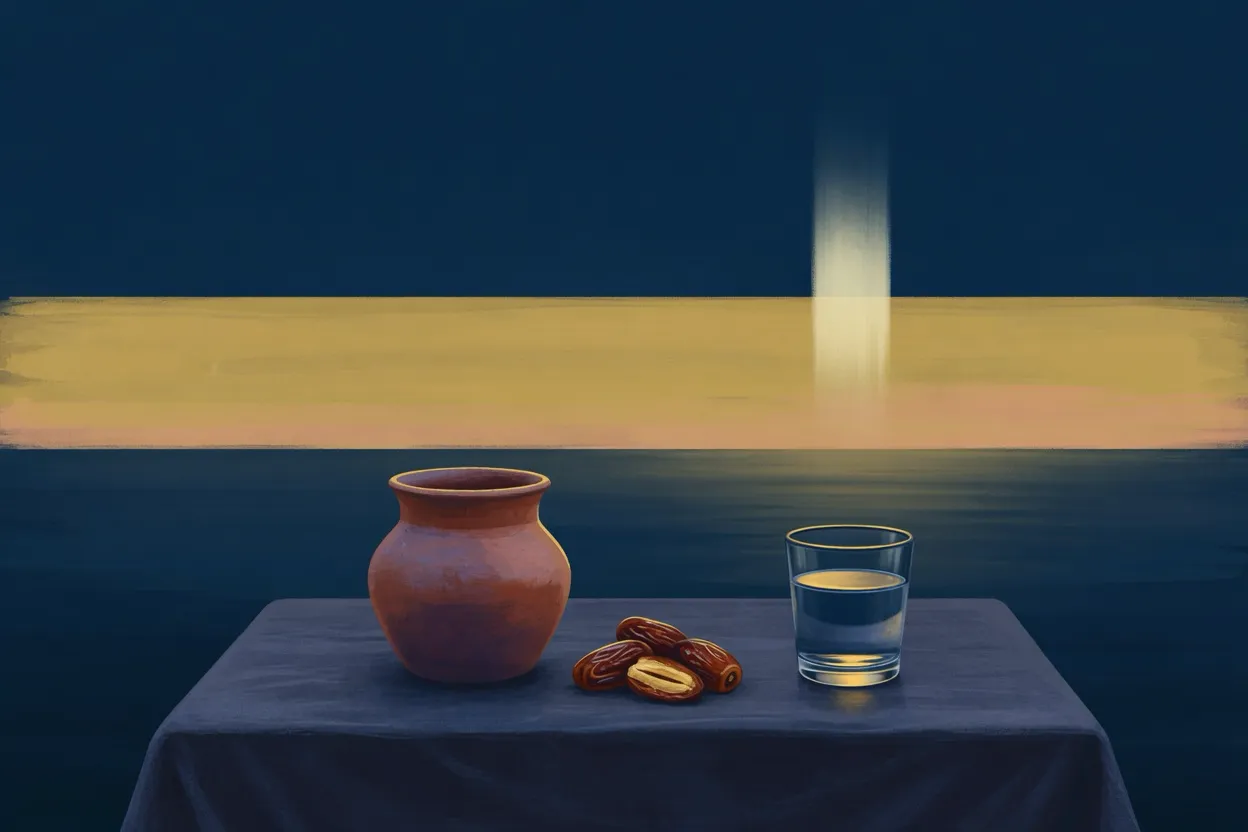
Suhoor looks like a breakfast. In the law it is a deadline. In the heart it is the first standing of the day: you were given another dawn. That delay is not a right you earned. It is time still in your hand.
The last bite you take in Ramadan and the first Allahu akbar of Fajr are timed by the same event in the sky: the true dawn. Not the clock on a cereal box. Not a cousin's WhatsApp. The moment the white of dawn spreads along the horizon and does not go back.
Allah says: eat and drink until the white thread of dawn becomes distinct to you from the black thread. Then complete the fast until the night (Qur'an 2:187). Night, for iftar, is Maghrib. Dawn, for suhoor, is Fajr. There are not three times. There are two edges of the day.
This page is for the edge that arrives while you are still chewing.
The two dawns, because one of them will trick you
Arabic refuses to call both of them "dawn" and leave it there.
The false dawn (al-fajr al-kadhib) is a pale vertical column that rises and then fades. It is real. In a dark enough sky you can see it. It does not start the prayer. It does not end the meal.
The true dawn (al-fajr al-sadiq) is a whitening that spreads horizontally along the horizon and stays. That is the thread in the verse. When it is distinct, the fork goes down and the prayer window opens.
We unpacked the observation, the 15° and 18° settings, and high latitudes in when Fajr starts and ends. Read that if you want the astronomy. The Ramadan consequence is simple and slightly uncomfortable:
For starting the prayer, waiting a few minutes after your app's Fajr is the cautious choice. For stopping the meal, the earlier time is the cautious choice.
Those two cautions pull in opposite directions. A single "safest" number does not exist. Anyone who sells you one number for both jobs is flattening the verse.
Why your app and the masjid disagree
Your phone is not watching the horizon. It is running a calculation: a solar depression angle, a method, a convention. ISNA, MWL, Umm al Qura, the Egyptian survey, the University of Islamic Sciences in Karachi: they do not all pick the same angle. Ten to twenty minutes of disagreement on Fajr is normal. On suhoor that gap is the difference between a lawful last sip and a sip you will wonder about all day.
Do this once, before the month, not at 4:12am on the third night:
- Pick a calculation method you can defend. The one your local mosque publishes is usually the one that will keep your community together.
- Set every app in the house to that method. Mixed methods are how families argue at the table.
- If you live where the sky never truly gets dark, follow a known high-latitude rule and a teacher who has used it. Do not invent a personal angle.
Imsak, if your calendar prints it, is not a third prayer. It is a buffer some communities put before Fajr so that nobody is still swallowing when the true dawn arrives. The Prophet ﷺ did not name a separate imsak time. If your mosque uses one, honour it as courtesy. Know that the legal line in the verse is still Fajr.
The blessing is in the meal, not in a special dua
"Take suhoor, for there is a blessing in it." (Sahih al-Bukhari 1923)
There is no required suhoor dua sitting next to the iftar wording. Eat. Intend the fast in your heart. Stop at true dawn. If you want words, Bismillah is enough. The older morning word still fits the dark kitchen: al-hamdu lillahi alladhi ahyana ba'da ma amatana. You slept. You were given the table again. That morning after a night you did not own is mercy, not a right. Eating in the dark, then standing for Fajr, is how the return becomes a deed.
Zaid ibn Thabit (may Allah be pleased with him) said they took suhoor with the Prophet ﷺ, then stood for the prayer. The interval was the time it takes to recite fifty verses (Sahih al-Bukhari 1921). That is not an hour of scrolling. It is a short, unhurried walk from the plate to the prayer rug. Delay the meal toward Fajr. Do not delay it into Fajr.
Dates and water are enough. A heavy suhoor that leaves you thirsty by Dhuhr is not more pious. It is just heavy.
How to wake for both, without becoming cruel to yourself
The 4am version of you will not become disciplined because a quote graphic told it to. The 11pm version of you has to do the work.
- Sleep as if Fajr is a flight. Our system for waking for Fajr is the same system, with one extra alarm: twenty minutes before Fajr for the meal, then Fajr itself.
- Put water and a date where your hand lands in the dark. Decision-making at 4am is a fantasy.
- If you miss the meal, the fast is still valid. Suhoor is a blessing, not a pillar. Drink something if there is time. If there is not, start the day and be kind.
- If you wake and the sky is already clearly lit, stop eating. Do not "finish the plate." Doubt after a clear dawn is appetite, not fiqh.
A Fajr alarm that can be told "twenty minutes before" is the right tool for this month. That is what Deeny's Fajr alarm is built to do, with a cap so a "before" setting cannot slide past sunrise. The meal is still yours to eat. The clock is just no longer a guess.
A small night-before ritual
- Set one method, one pair of times, on every screen in the house.
- Put the plate out. Dates, water, something salty, something with protein if you know your morning.
- Sleep.
- Eat in the dark without the news.
- Stop at the Fajr you chose, or at imsak if that is your mosque's courtesy.
- Pray Fajr before the house becomes a conversation.
Iftar, later, is Maghrib: dates or water, the dua, then the prayer. Same two edges. Same refusal to let the meal become the master of the hour.
Frequently Asked Questions
When exactly do I stop eating for suhoor?
At true dawn, the start of Fajr. That is the white thread becoming distinct from the black in Qur'an 2:187. If your mosque prints an earlier imsak, stopping then is a precaution, not a second revelation.
Does eating a minute after Fajr break the fast?
If you know Fajr has entered and you keep eating on purpose, that day's fast is broken and you make it up. If you are unsure and the sky is still dark, stop as soon as the time you trust arrives. A local teacher is the right person for an edge case, not a comment section.
Why is suhoor time different from Fajr time on some calendars?
Those calendars are printing imsak, a buffer before Fajr. The legal event is still Fajr. Ask which one your mosque wants the community to follow, then follow it together.
I slept through suhoor. Is my fast valid?
Yes, if you intended to fast before dawn. The meal is a blessing (Sahih al-Bukhari 1923), not a condition. You will be hungrier. The day still counts.
Can I brush my teeth after Fajr in Ramadan?
Water in the mouth that you do not swallow is not food. Be gentle, spit well, and do not turn wudu into a drink. If you are anxious, finish the brushing before Fajr. Forgetting and swallowing a little water by accident does not break the fast.
The month will ask you to stop twice a day: once when the horizon turns white, once when it turns to night. Learn the first stop as carefully as you learn the second. A last sip taken in the dark, on purpose, then a prayer that is not late, is already a kind of taqwa. The rest of the daylight can work from there.